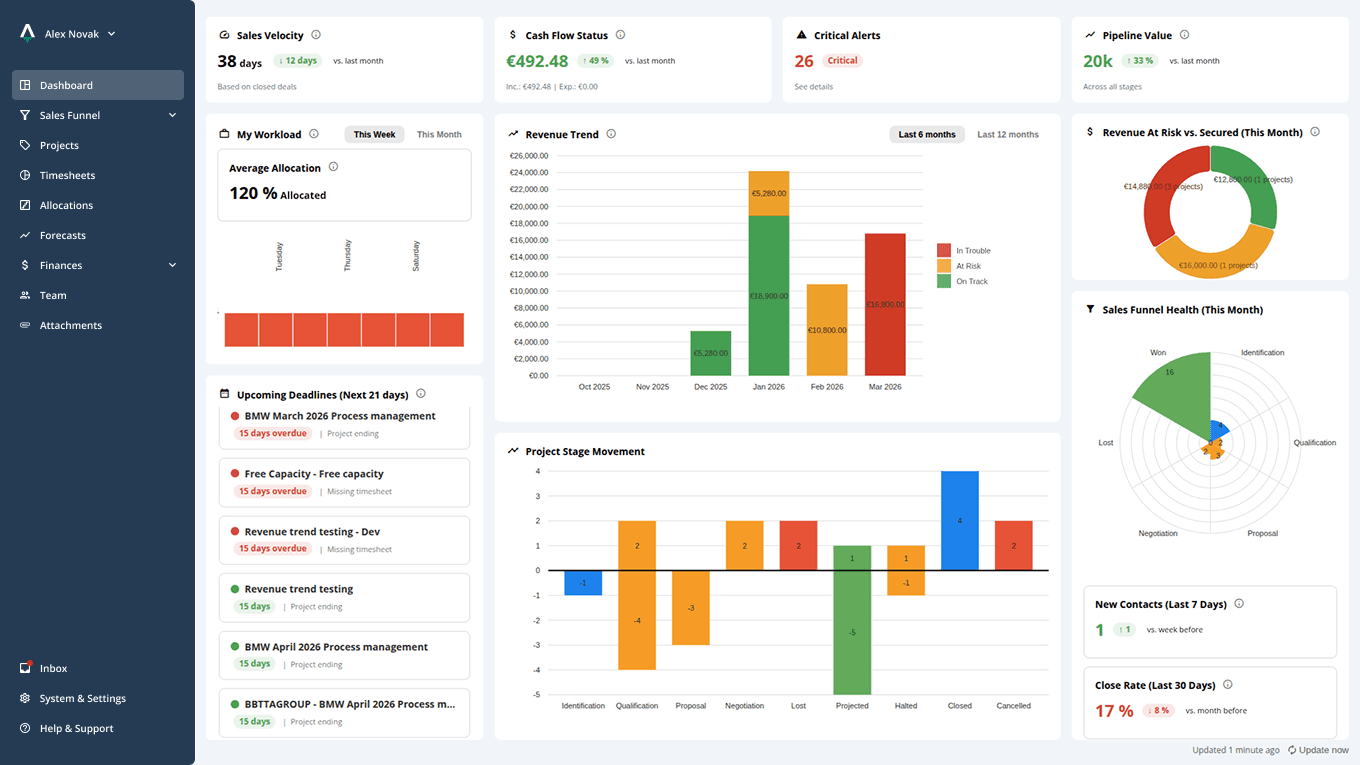
·
8
min read
From Prospects to Portfolios: Building Smarter Client Intelligence with LEAP Companies

Michal Magula
Product Lead

You can name your ten biggest clients from memory. But can you say, without opening five tabs, who owns each account, which projects are live, what you have invoiced this year, and whether the relationship is still profitable? For most agencies the honest answer is no. The client lives in someone's inbox, the projects in a tool, the invoices in accounting, and the "real" status in a spreadsheet only one person updates.
That gap is exactly where account management software for agencies earns its place. It pulls every client, partner, and entity into one record so the company, not just the contact, becomes something your whole team can see and act on. The pain shows up the moment growth outpaces memory: a junior account manager inherits a client and has no idea what was promised, or finance chases an invoice for work nobody logged.
Account management software for agencies is a system that stores each client company as a single connected record — linking its people, projects, invoices, ownership, and history — so the whole firm shares one trustworthy view of every account instead of reconstructing it from scattered files. In LEAP, that record is the Companies module, and it sits inside the same tool that runs your sales, delivery, and billing.
Why scattered client data quietly costs agencies money
Fragmented client data is not a tidiness problem. It is a revenue problem. When the record of a client lives across an inbox, a project board, an accounting tool, and a personal spreadsheet, nobody owns the truth. Decisions get made on stale numbers, and the cost lands later as a missed renewal or a job that lost money without anyone noticing in time.
The scale is documented. According to Validity's The State of CRM Data Management in 2025, 76% of organisations say less than half of their CRM data is accurate and complete, and 37% reported losing revenue as a direct consequence of poor data quality. For a service firm, "poor data" usually means exactly this: client information that exists, but not in one place anyone trusts.
Retention raises the stakes. CustomerGauge's 2025 B2B benchmarks put the average churn rate for professional services firms at 27% — roughly a third of the client base at risk every year. You cannot defend a portfolio you cannot see. Account-level visibility is what turns "we think that client is happy" into "this account has two live projects, a renewal in 60 days, and an unpaid invoice we should resolve first."
What account management software for agencies should hold in a company record
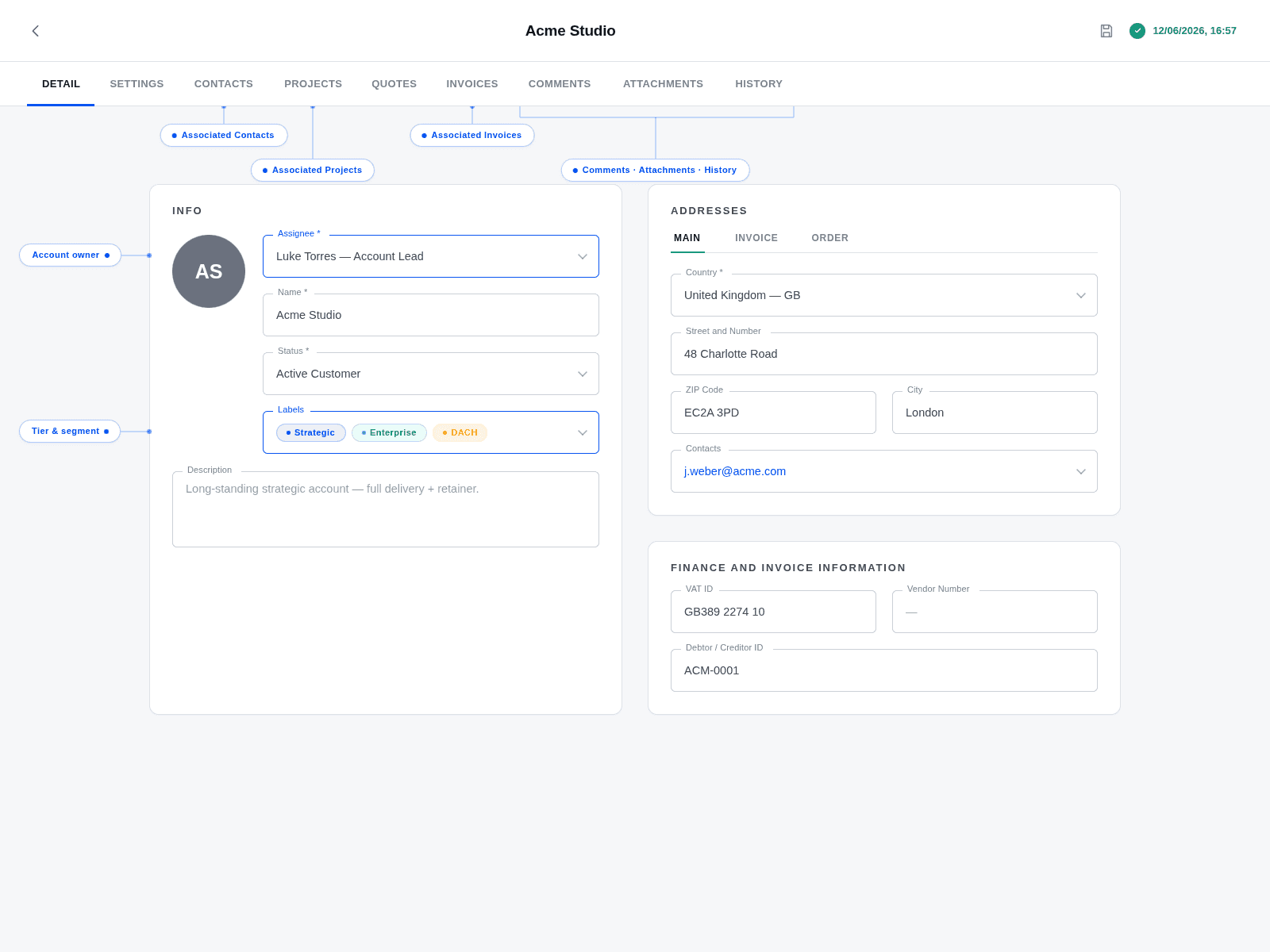
A useful company record is more than a name and a logo. It is the spine that connects everything you do for that client. In LEAP, each company in the Companies module brings the relationship together in one place rather than scattering it across tools: one record, many linked threads.
Account settings and identity: the master record for the client, partner, or entity — created, edited, and managed through standard list and CRUD operations.
Associated contacts: the people who belong to that company, so you see the buying committee and the day-to-day team in context, not as loose name cards – giving you a single source of truth for client contacts and relationships.
Projects: every engagement running under the account, linked back to the company so delivery and the client are never two separate stories – with LEAP Projects keeping those engagements financially precise, from budgets to margins.
Invoices: the commercial history — what has been billed against the account — visible from the same record, with LEAP Invoices closing the revenue loop and keeping billing history effortless and accurate.
Account ownership: a named assignee per account, so responsibility is explicit and handovers stop being guesswork.
Labels: tags to segment the portfolio — by tier, sector, status, or whatever your firm sorts by.
Comments, attachments, and history: the running notes, the signed documents, and an audit trail of changes, all attached to the company itself.
The point is not the length of the list. It is that one click on a company answers the questions an account review actually asks, instead of sending you hunting.
From contacts to companies: two views of the same relationship
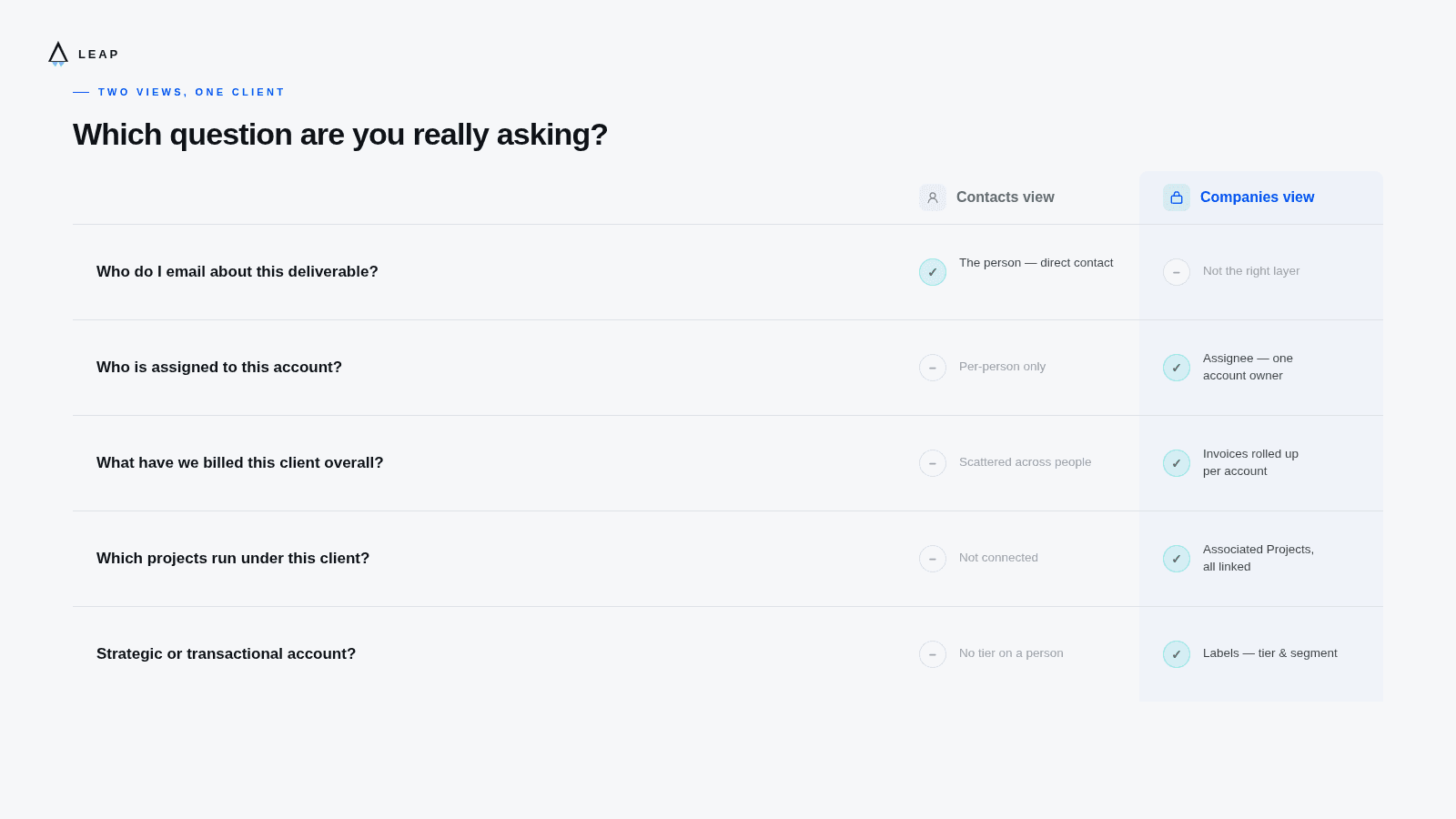
People and companies are not the same object, and treating them as one is where a lot of CRMs blur. A contact is an individual — the marketing lead you email, the finance person who approves invoices. A company is the account that contains them and the work. You need both, linked, but you read them differently.
Question you are asking | Contacts view | Companies view |
|---|---|---|
Who do I email about this deliverable? | Yes — the individual | Indirectly, via associated contacts |
Who is assigned to this account? | No | Yes — account assignee |
What have we billed this client overall? | No | Yes — associated invoices |
Which projects run under this client? | No | Yes — associated projects |
Is this a strategic vs transactional account? | No | Yes — labels and history |
For deep work on the people side, the Contacts module handles individuals and their details. The Companies module is the portfolio layer above it: the account, its work, and its money. Together they give you the relationship in full — the person you talk to and the business behind them.
Account ownership and the portfolio view that scales
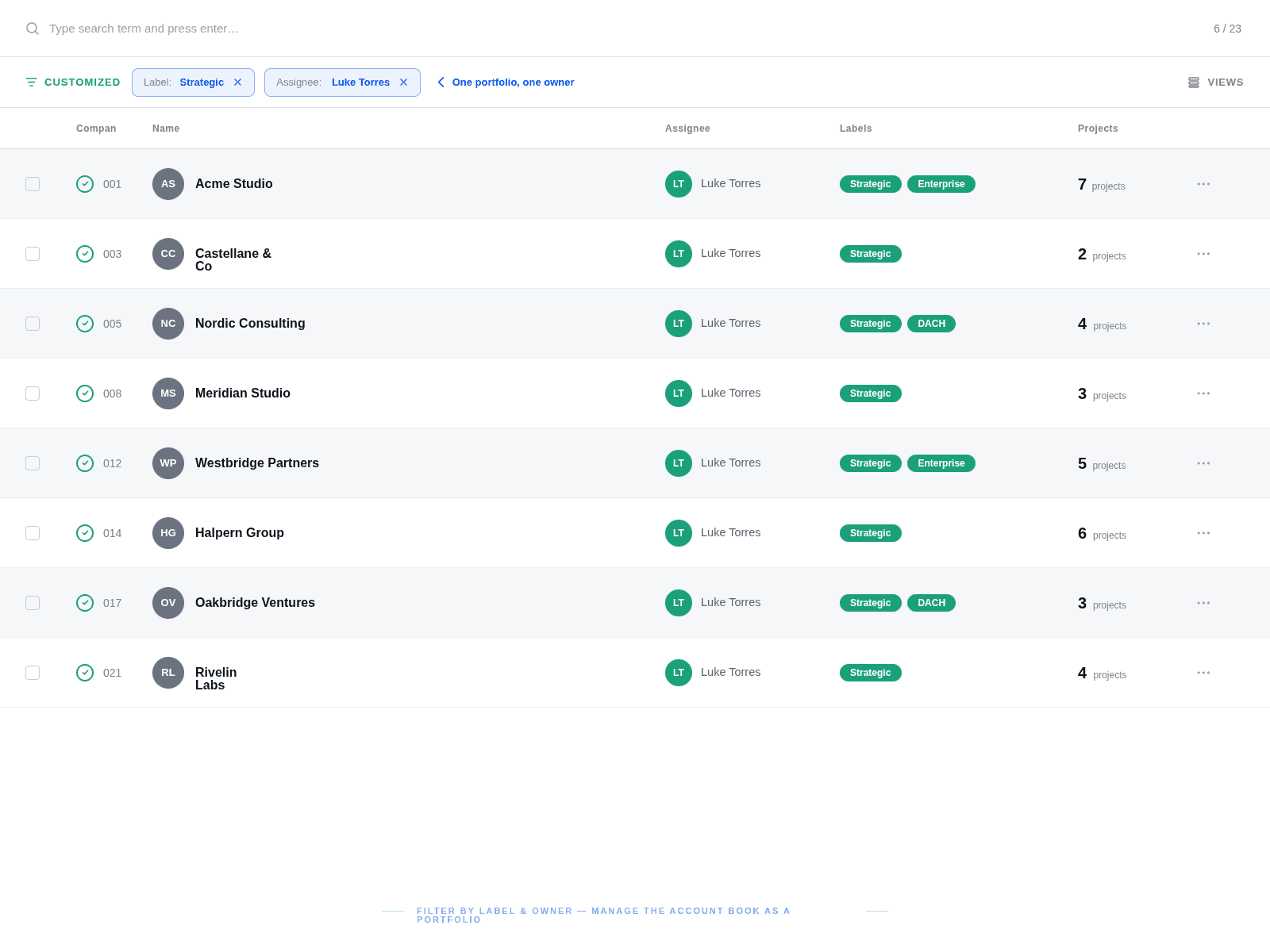
The single biggest reason account management breaks as a firm grows is unclear ownership. When "who looks after this client?" has no recorded answer, accounts drift. Renewals slip because everyone assumed someone else was watching. LEAP records a named assignee on each company, so every account in the portfolio has an accountable person, and a handover is a reassignment rather than an archaeology project.
Ownership plus labels turns a flat client list into a portfolio you can manage as a discipline. A consultancy can label accounts by tier and filter to its top-20 for a quarterly review. An engineering firm can segment by sector to see concentration risk. A software agency can tag accounts up for renewal and work that list deliberately. Concrete example: an agency with 80 clients can, in one view, see which 12 accounts a single assignee carries, spot the two with no live project, and reassign before the relationship goes cold.
Comments and attachments keep the context with the account, not in someone's head. The next person to open the company sees the last conversation, the contract, and the history of changes. That continuity is what lets a team — rather than a single person carrying it all — run the book of business.
Where Companies fits in one connected system
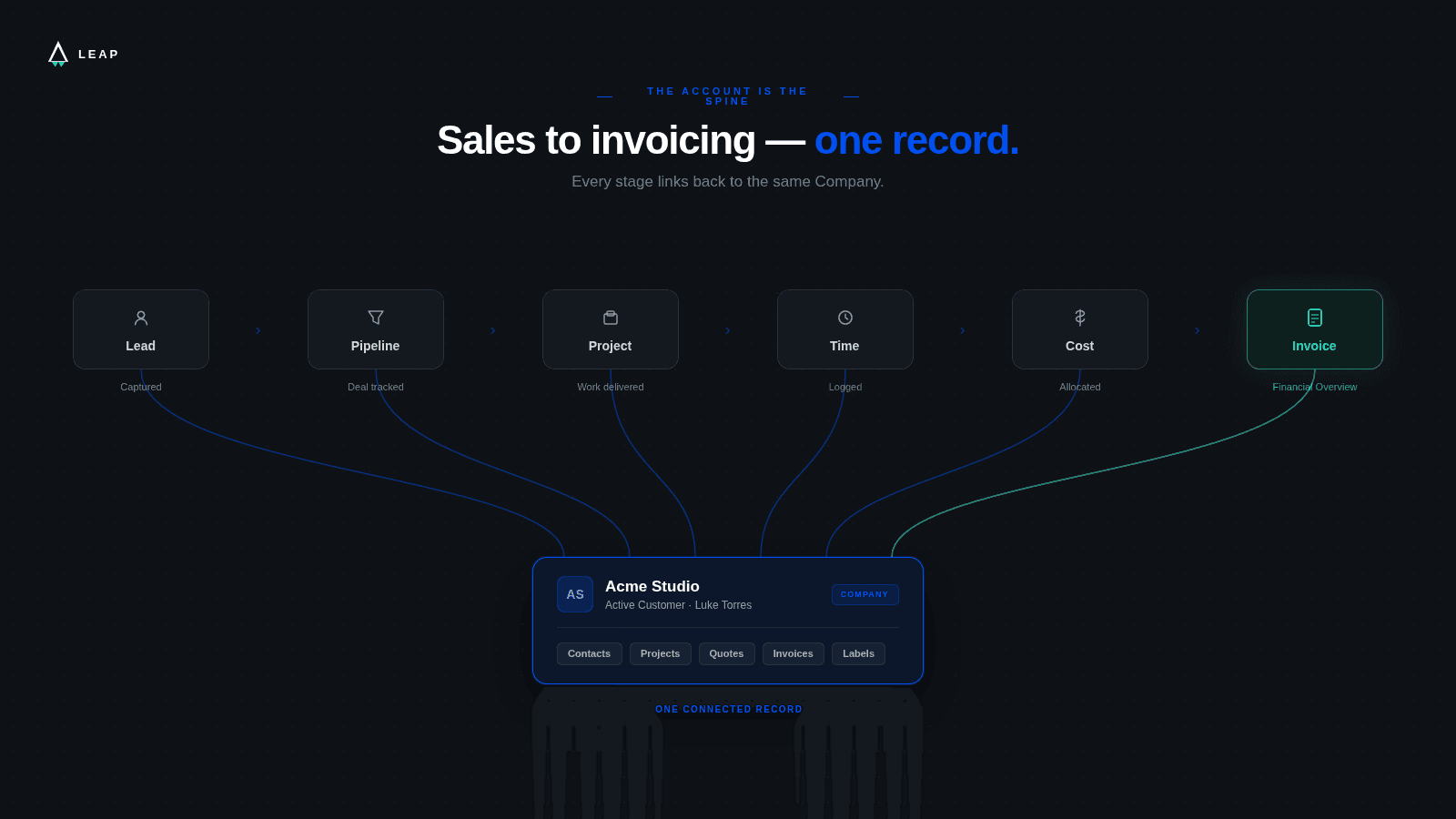
A company record only earns "intelligence" when it connects to the work and the money. This is the difference between a standalone CRM and an ERP-plus-CRM built for service firms. In LEAP, the chain runs in one tool: a lead becomes a pipeline opportunity, becomes a project under a company, accrues time and cost, and turns into a compliant invoice — all linked back to the account.
That means the Companies module is not a static address book. Open a client and you reach the projects driving the relationship and the invoices proving its commercial value, because they live in the same system. The promise behind LEAP — run the work, see the money — depends on exactly this linkage: the company record is where "who we work with" meets "whether it pays."
An honest note on scope. LEAP's permissions are role-based. Onboarding and any data migration are guided and demo-led rather than self-serve, so moving an existing client book in is hands-on with our team. The audit history exists across modules, but LEAP makes no formal certification claims. We would rather you know the edges than discover them later.
FAQ
What is account management software for agencies?
It is software that stores each client company as one connected record — linking its contacts, projects, invoices, ownership, and history — so the whole firm shares a single trustworthy view of every account. For agencies, this replaces the usual mix of inbox, project tool, accounting system, and a private spreadsheet that only one person keeps current.
What is the difference between a contact and a company record?
A contact is an individual person you communicate with; a company is the account that contains those people and all the work you do for them. You manage people in the Contacts module and accounts in the Companies module, with the two linked. The company view is where ownership, projects, and invoice history come together at the portfolio level.
How does account ownership help a growing service firm?
Recording a named assignee on each company removes the "who looks after this client?" ambiguity that causes accounts to drift as a firm scales. Assigning an account makes responsibility explicit, makes handovers a clean reassignment, and lets you see exactly which accounts each person carries. Combined with labels, it turns a flat client list into a portfolio you can review by tier or sector.
Can I see a client's projects and invoices from one place?
Yes. In LEAP, a company record links its associated projects and invoices, so you can open one account and see the work running under it and what has been billed against it. Because LEAP unifies sales, delivery, and invoicing in one tool, those links are live rather than copied between systems.
Does the company record keep a history of changes?
LEAP keeps comments, attachments, and a history/audit trail on the company record, so the last conversation, the signed documents, and the record of changes stay with the account. This gives a new account assignee the context without relying on anyone's memory. Note that LEAP makes no formal compliance certification claims.
Key takeaways
Account management software for agencies stores each client as one connected record — contacts, projects, invoices, ownership, and history — instead of scattering the relationship across separate tools.
Validity's State of CRM Data Management in 2025 found 76% of organisations say less than half their CRM data is accurate and complete, and 37% lost revenue directly because of poor data quality.
With professional-services churn averaging 27% (CustomerGauge, 2025), account-level visibility is a retention tool: you cannot defend a portfolio you cannot see.
Contacts are people; companies are accounts. LEAP keeps them as distinct, linked objects so you read individuals and portfolios in the right view.
Named account assignment plus labels converts a flat client list into a managed portfolio you can filter by assignee, tier, or sector and review deliberately.
In LEAP, the company record connects to live projects and invoices in the same tool, so "who we work with" and "whether it pays" sit in one place.
Get a free LEAP walkthrough
If your client truth currently lives in an inbox plus a spreadsheet, the LEAP Companies module is one way to bring it into a single connected record alongside the projects and invoices it relates to. Onboarding is guided and demo-led, so the best way to judge the fit is to walk a real account through it with us. References are available on request.