·
6
min read
The Single Source of Truth: Why LEAP Contacts Turn Conversations into Opportunity

Michal Magula
Product Lead

Most businesses do not lose deals because of poor intent. They lose them because context is scattered: half the story sits in one inbox, the rest in a chat thread, a sticky note, and a spreadsheet only one person knows how to read. When that one person is on holiday, off sick, or has left, the relationship goes quiet.
The fix is not more tools. It is a single source of truth for client relationships — one place where the full history of a contact lives, so anyone who picks up the account can see what was promised, what was discussed, and what happens next. A single source of truth for client relationships is a single, shared record per contact that holds their core details, comments, attachments, links, and full interaction history, so every team works from the same facts instead of their own fragments.
This is the gap Excel and a shared inbox cannot close. They break down the moment your team needs one shared, trustworthy view of who you are working with. LEAP Contacts gives every client relationship a structured home.
Why scattered context quietly costs you deals
Fragmented client data is not a tidiness problem. It is a revenue problem. When the same contact lives in five places, no version is complete, and the gaps surface at the worst moments: a renewal call where nobody remembers the last complaint, a kickoff where delivery has not seen the sales promises, a handover where the new account lead starts from zero.
The numbers back this up. In Validity's State of CRM Data Management in 2025 report, 76% of CRM users said less than half of their organisation's CRM data is accurate and complete, and 37% reported losing revenue as a direct consequence of poor data quality. Scattered context is the upstream cause of both.
For service and project-based firms the stakes are higher than for transactional sellers. Your relationships span months, not minutes. A consultancy might touch a client across discovery, proposal, delivery, and three rounds of change requests. If that thread is spread across personal inboxes, the institutional memory walks out the door every time someone changes role.
What a single source of truth for client relationships actually contains
A real source of truth is more than a name and an email. It is the living record of a relationship. In LEAP, a single contact record holds the elements that let any colleague step in without re-asking questions the client already answered.
Core details — the identity and reach information for the person you work with.
Internal comments — private context your team adds (decision-maker, prefers email, renewal is sensitive) that never leaks to the client.
File attachments — the signed brief, the spec, the screenshot, kept on the record instead of buried in a thread.
Labels — lightweight tags to segment and find contacts fast (VIP, at-risk, partner).
Assignees — who owns the relationship, so accountability is explicit rather than assumed.
Company links — the contact connected to its organisation, so the person and the account are never orphaned from each other.
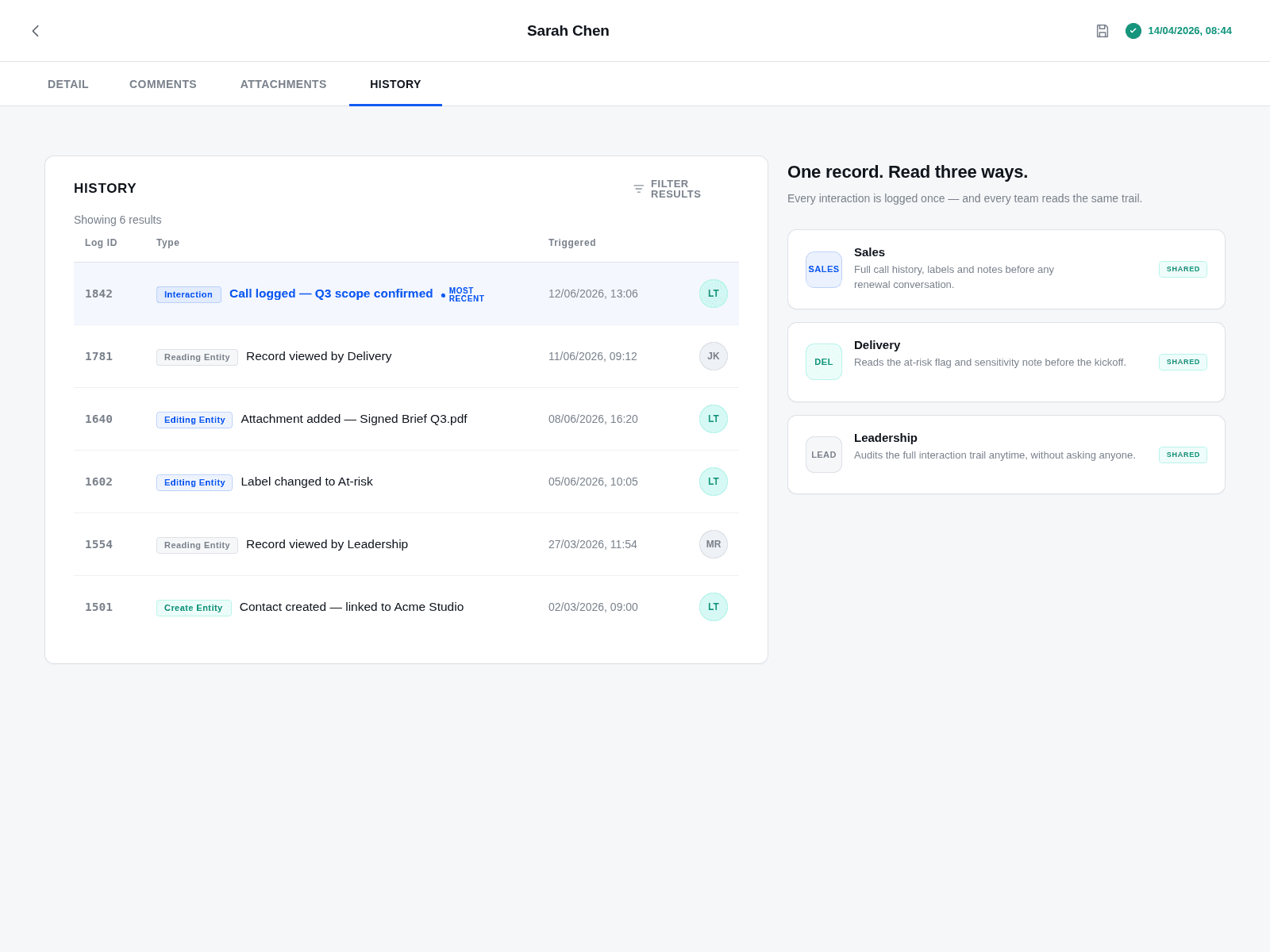
Interaction history — a running, timestamped trail of what happened, so the story reads top to bottom.
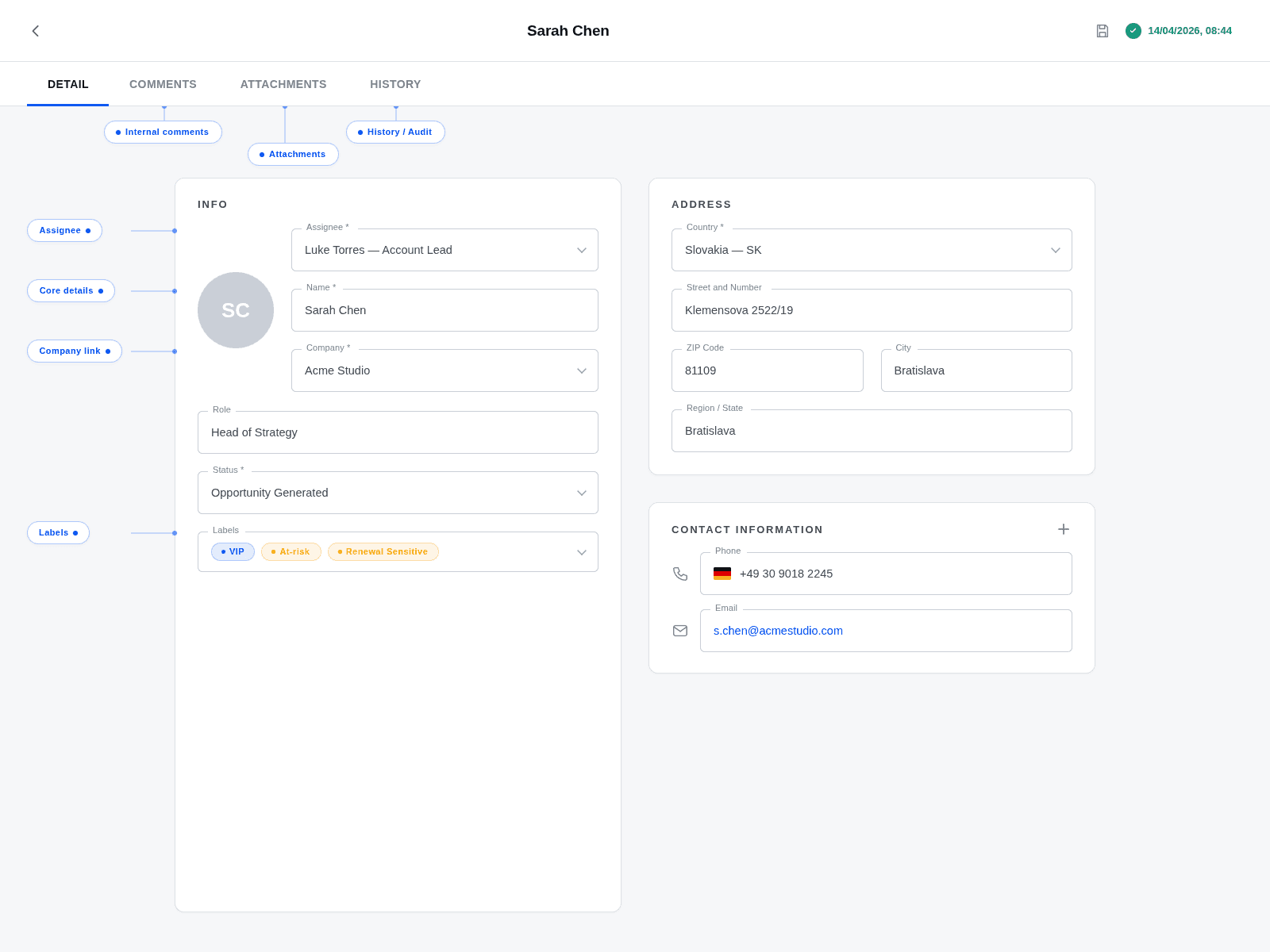
Put together, that is shared relationship memory. The point is not that any single field is clever. It is that they sit in one record, visible to the people who need them, instead of in seven systems that never agree.
Inbox and spreadsheet vs. a shared contact record
Most teams do not choose scattered data on purpose. They grow into it: an inbox here, a spreadsheet there, a chat channel for the rest. Here is what changes when the relationship lives in one record instead.
Question on a Monday morning | Inbox + spreadsheet | Shared LEAP contact record |
|---|---|---|
What did we last promise this client? | Search three inboxes, hope the right person is online | Read the interaction history on the record |
Who owns this account? | Implied, often disputed | Named assignee on the record |
Where is the signed brief? | Attached to an email someone forwarded | Attachment on the contact |
Is this contact sensitive or at-risk? | Tribal knowledge in one head | Internal comment + label |
How does this person fit the wider account? | Manual cross-referencing | Company link on the record |
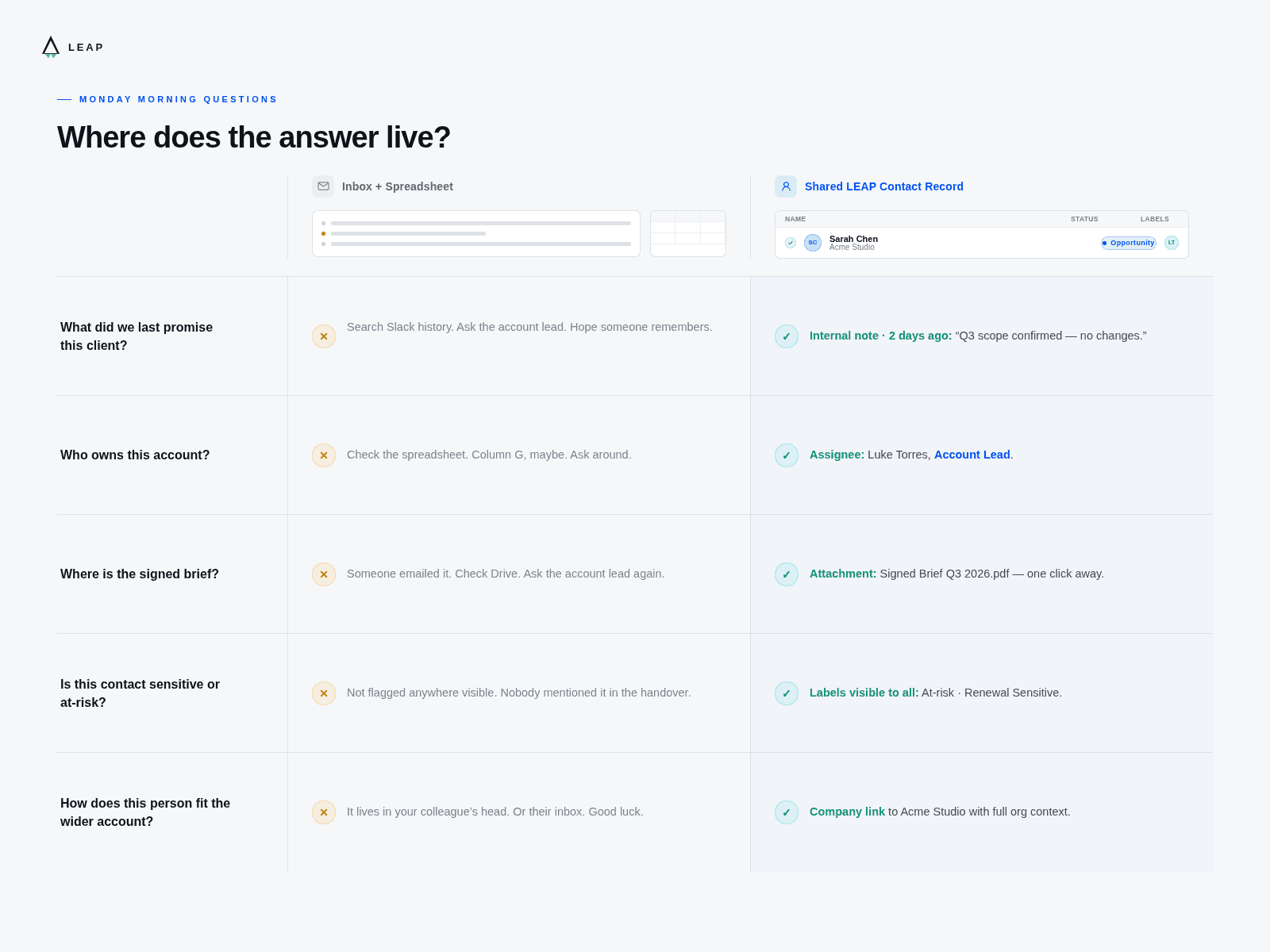
The spreadsheet column wins on day one and loses every day after, because it has no memory and no owner. The record wins because it accumulates context instead of losing it.
How three teams read the same record differently
A good source of truth serves several jobs from one set of facts. Nobody has to chase an update, because the update is already on the record.
Sales sees relationship status before a call: last contact, open promises, the label that says renewal is sensitive. No cold-opening a warm account.
Delivery reads the client background and attachments before kickoff, so the brief is not re-explained and the spec is not re-requested.
Leadership reviews account activity and history without pinging anyone, because the interaction trail and audit history are already there.
For an agency, that means the account manager who built the relationship and the producer who delivers it work from the same record. For a consultancy, the partner who sold the engagement and the consultant who runs it share one history. The relationship stops being a single person's private knowledge and becomes the firm's asset.
Where Contacts sits in the bigger picture
A contact record is the front door, not the whole house. In LEAP, that same client thread connects forward: the contact links to its company, the company to its pipeline and projects, projects to time, cost, and compliant invoicing. That is the one-source-of-truth path from first conversation to financial overview, in one connected tool rather than a CRM bolted to a finance spreadsheet.
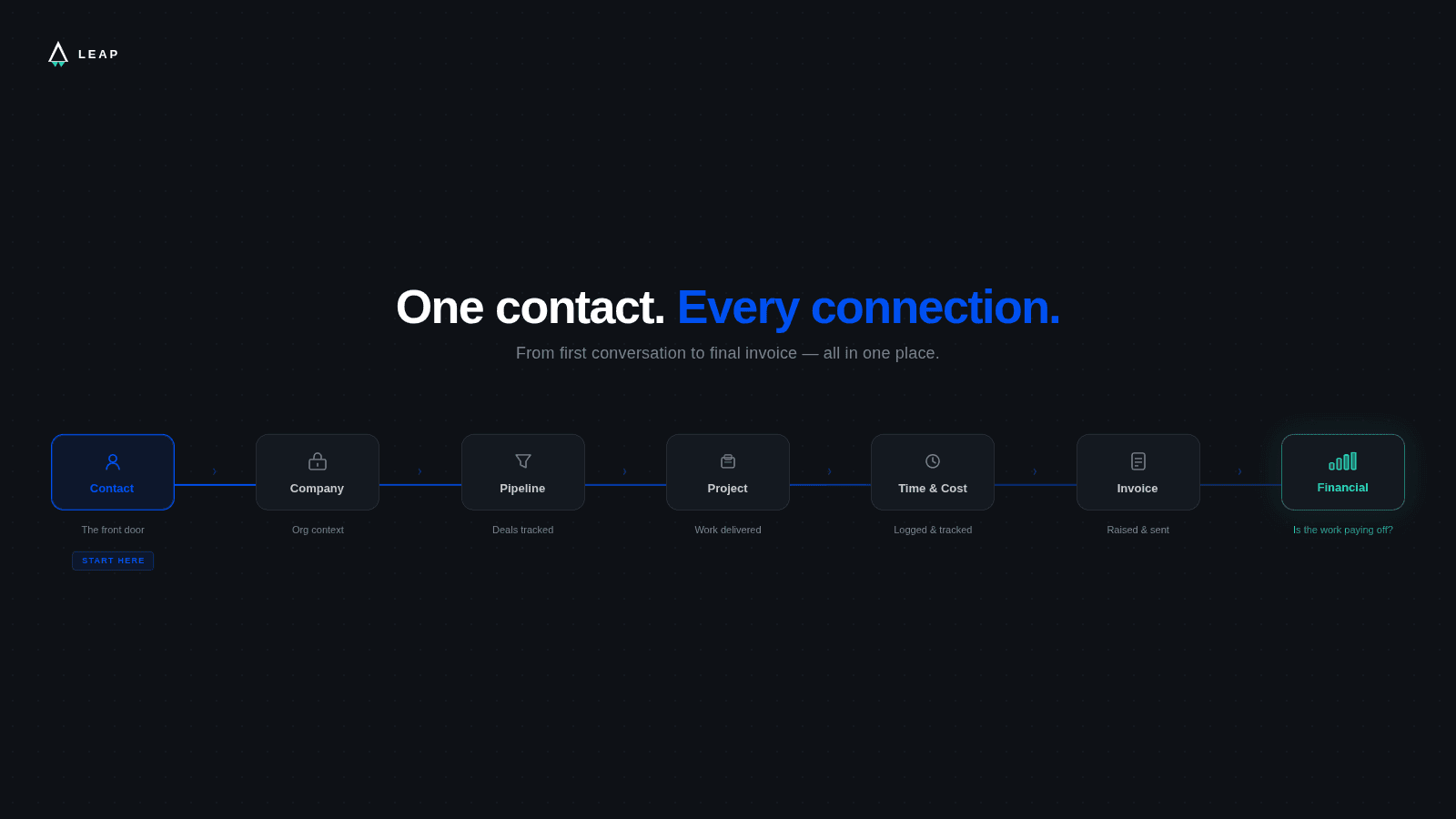
So the value of Contacts compounds. Clean relationship memory at the top of the funnel means the project that follows, and the invoice after that, inherit the same trustworthy context. You are not just tidying a contact list. You are setting the foundation for whether the work is making money.
FAQ
What is a single source of truth for client relationships?
It is one shared record per contact that holds their details, internal comments, attachments, labels, owner, company link, and full interaction history. Because every team reads and writes to the same record, there is no arguing over which inbox or spreadsheet has the current version. The relationship becomes a company asset rather than one person's private knowledge.
How is client contact management software different from a spreadsheet?
A spreadsheet stores fields; it has no memory of interactions, no clear owner, and no place for attachments or context. Client contact management software keeps a running, timestamped interaction history on each record, assigns an accountable owner, and links the contact to its company. It accumulates context over time instead of going stale the moment someone stops updating a cell.
Can different teams see the same contact in LEAP?
Yes. Sales, delivery, and leadership all read the same contact record, each pulling the part they need — relationship status, client background, or account activity. The History tab records who viewed or edited the contact and when, so the same set of facts is shared across the team.
What does a LEAP contact record actually hold?
Core details, internal comments, file attachments, labels, assignees, company links, and a running interaction history, plus history and audit visibility. You can list, create, edit, and search contacts, and attach files and comments directly to the record. Everything about the relationship sits in one place.
Key takeaways
A single source of truth for client relationships is one shared record per contact — details, comments, attachments, labels, owner, company link, and interaction history — not a row in a spreadsheet.
In Validity's 2025 report, 76% of CRM users said less than half their CRM data is accurate and complete, and 37% lost revenue to poor data quality; scattered context is the upstream cause.
Inboxes and spreadsheets win on day one and lose every day after, because they have no memory and no clear owner; a shared record accumulates context instead.
Sales, delivery, and leadership read the same LEAP contact record differently, so nobody chases an update — the update is already on the record.
Contacts is the front door to LEAP's connected path: contact to company to project to time, cost, and compliant invoicing in one tool.
LEAP is honest about scope: onboarding and migration are guided rather than self-serve.
Get a free LEAP walkthrough
If client context is scattered across inboxes, chat, and spreadsheets, a shared contact record is a low-risk place to start consolidating. LEAP Contacts is one way to give every relationship a structured home and a single source of truth for client relationships — alongside the projects, time, and invoicing they feed. An honest note: permissions are role-based, onboarding is guided and demo-led, and migrating your existing contacts is hands-on with you during onboarding rather than a self-service import. If that is the problem you are trying to solve, a guided walkthrough is the honest next step. References available on request.